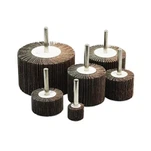
② When the contact area between the abrasive and the workpiece surface is relatively large, or the grinding depth is also large, abrasive with coarse particle size should be selected. Coarse-grained abrasives have less friction and less heat on the workpiece surface. Therefore, when grinding with the end face of the grinding wheel, the granularity of the selected abrasive can be thicker than that of the peripheral grinding of the grinding wheel. Usually. The with 36#~46# particle size is used for flat grinding, and the workpiece surface roughness value Ra can reach 0.8~0.4μm. If the grinding wheel speed vs is increased and the grinding depth ap is reduced, the workpiece surface roughness value Ra can reach 0.4μm~0.2μm. During fine grinding, the abrasive with 150#~240# particle size is used for grinding, and the workpiece surface roughness value Ra reaches or lower. In the mirror grinding, the use of micro-powder W10~W7 size of the resin bond graphite grinding wheel.
⑥ Grinding materials with high hardness, such as quenched steel, alloy steel, etc., should choose coarse-grained abrasive. When grinding cemented carbide, due to the poor thermal conductivity of the material, it is easy to produce burns and cracks, so it is appropriate to choose abrasive with coarse particle size. For the grinding of thin and thin-walled workpieces, abrasive with coarser particle size should also be selected because of its easy heat deformation.
(7) For the cutting allowance is small, or the workpiece with small contact surface of the abrasive and the workpiece, you can choose a finer particle size of the abrasive. Compared with the abrasive tools used for wet grinding, the abrasive particle size can be finer.
⑩ In high-speed grinding, in order to improve the grinding efficiency, the particle size of the abrasive is 1 to 2 particle sizes smaller than that of ordinary grinding. Because the fine particle size is sharp, it is easy to cut into the workpiece. At the same time, the grinding wheel has more grinding particles per unit working area, and the force on each grinding particle is smaller, so it is not easy to dull. In addition, even if individual abrasive particles fall off, the impact on the uneven wear of the grinding wheel is not as large as the coarse particle size, so it is conducive to maintaining the smoothness of the grinding process. However, the grain size of the grinding wheel can not be too fine during high-speed grinding, otherwise the chip removal conditions will become worse, which is not conducive to improving the grinding efficiency.
In general, medium particle size abrasives are most commonly used. Fine-grained abrasives are usually only used in fine grinding, grinding and polishing. In batch production, under the premise of meeting the requirements of workpiece roughness, abrasive with coarse particle size should be selected as far as possible to improve production efficiency. In small batches or single production, the processing quality of the workpiece is generally considered, so it is more advantageous to choose some fine-grained abrasives. The application range of abrasives with different particle sizes is shown in Table
|
14# |
|
|
14#~30# |
|
|
30#~60# |
|
|
60#~100# |
|
|
100#~240# |
|
|
150#~W20 |
|
|
W28 and more finer |
For ultra-fine grinding, mirror grinding, fine grinding and polishing |